Hair Type
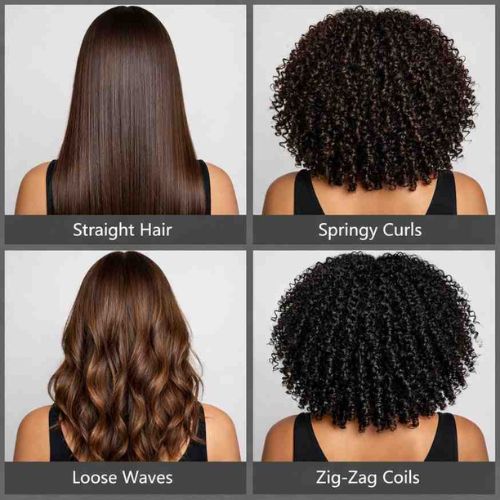
Understanding your hair and Find Your Hair Type is the first step to building the right hair care routine. Many people wonder how to find their hair type and why their hair behaves differently. Hair textures are usually divided into straight, wavy, curly, and coily hair types. Each hair type has unique needs such as moisture, frizz control, or scalp care. Learning about the hair type chart (1A–4C) helps you identify your natural hair texture easily. Once you can Find Your Hair Type, you can follow the best home hair care tips for healthy hair growth.
Quick Guide to Hair Categories
1 . Straight Hair
No curls or waves, hair falls straight from root to tip.
2. Wavy Hair
Natural “S” shaped waves with medium texture.
3. Curly Hair
Visible curls or ringlets with volume.
4. Coily Hair
Very tight curls or zig-zag coil pattern.
Complete Hair Type Chart Guide (1A–4C)
| Hair Type | Texture Pattern | Description | Common in India |
|---|---|---|---|
| 1A | Very straight | Fine, silky hair with no wave or curl | Rare |
| 1B | Straight | Slight volume, holds styles better than 1A | Some people |
| 1C | Straight & thick | Straight but coarse with slight bends | Common |
| 2A | Loose waves | Soft “S” shaped waves, light texture | Very common |
| 2B | Defined waves | Noticeable waves with some frizz | Very common |
| 2C | Thick waves | Strong waves almost forming curls | Common |
| 3A | Loose curls | Large, soft curls with bounce | Less common |
| 3B | Springy curls | Tighter curls with more volume | Rare |
| 3C | Tight curls | Corkscrew curls, very dense hair | Rare |
| 4A | Soft coils | Tight coil pattern, very thick hair | Rare in India |
| 4B | Zig-zag coils | Less defined curl pattern | Very rare |
| 4C | Very tight coils | Dense, fragile hair with shrinkage | Extremely rare |
Above the chart that helps Find Your Hair Type
1. Very Straight Hair (1A)
Very straight hair usually looks smooth and shiny, but it can become oily very quickly because the natural oils from the scalp travel easily down the hair shaft. This hair type often lacks volume and may appear flat or lifeless. Another difficulty is that it does not hold curls or hairstyles easily, so styling options can be limited. People with very straight hair may also need to wash their hair more frequently to keep it fresh and clean.
How to Maintain
- Wash hair 2–3 times a week with a lightweight shampoo.
- Use very little conditioner to avoid greasy hair.
- Apply dry shampoo to add volume.
- Avoid heavy oils because they make hair flat.
- Use a volumizing spray for better texture.
2. Straight Hair (1B)
Straight hair with slight volume is generally easy to manage, but it can still develop an oily scalp if not washed regularly. Dust and pollution can easily stick to straight hair, especially in humid climates. Sometimes the hair may look limp or heavy without proper styling. Maintaining balance between cleanliness and moisture can be a small challenge for this hair type.
How to Maintain
- Apply light conditioner on the ends only.
- Massage scalp with coconut oil once a week.
- Avoid over-brushing to prevent hair fall.
- Use heat protectant before styling tools.
3. Straight & Thick Hair (1C)
Straight and thick hair is strong and full, but it can sometimes become frizzy, especially in humid weather. Because the hair strands are thicker, the hair may feel heavy and may take longer to dry after washing. Styling thick straight hair can also be difficult because it does not always stay in place easily. Proper hydration and occasional conditioning help manage these issues.
How to Maintain
- Use moisturizing shampoo and conditioner.
- Apply hair serum to control frizz.
- Oil massage with coconut oil or almond oil weekly.
- Trim hair every 6–8 weeks.
- Comb a wide-tooth comb to avoid breakage.
4. Loose Waves (2A)
Loose wavy hair has a gentle wave pattern that looks natural and soft. However, the waves may lose their shape easily, especially after brushing or sleeping. This hair type can also develop mild frizz, particularly in humid environments. Maintaining the natural wave pattern without making the hair look messy can sometimes be challenging.
How to Maintain
- Suggest lightweight conditioner for hydration.
- Scrunch hair gently while drying to enhance waves.
- Avoid brushing dry hair to reduce frizz.
- Use leave-in conditioner occasionally.
- Sleep on a soft pillowcase to protect waves.
5. Defined Waves (2B)
Defined wavy hair has more noticeable waves, which can make the hair look voluminous and attractive. However, this hair type is more prone to frizz and dryness at the ends. The waves can also become uneven or messy if the hair is not properly moisturized. Gentle care and light hydration are often needed to keep the waves looking defined.
How to Maintain
- To control frizz, use an anti-frizz shampoo and conditioner.
- For better wave definition, apply curl cream or mousse.
- Meanwhile, avoid excessive heat styling.
- After washing, detangle your hair while it is slightly damp.
- To reduce frizz further, use a microfiber towel.
6. Thick Waves (2C)
Thick wavy hair usually has strong wave patterns and good volume, but it can also become very frizzy in humid weather. Detangling thick waves may take more time because the hair strands are dense. Without enough moisture, the waves may look rough or dry. Managing frizz and keeping the hair hydrated is often the biggest challenge.
How to Maintain
- To keep your hair healthy, deep condition it once a week.
- For better curl definition, use curl-enhancing products.
- At the same time, avoid brushing your hair when it is dry.
- Instead, use a wide-tooth comb after washing your hair.
- Finally, apply light oils like argan oil for extra shine.
7. Loose Curls (3A)
Loose curly hair forms soft, bouncy curls that can look very beautiful. However, curls tend to lose moisture quickly, making this hair type prone to dryness. The curls may also tangle easily, especially if the hair is brushed when dry. Maintaining curl definition and preventing dryness are the main difficulties for this hair type.
How to Maintain
- First, use a moisturizing shampoo specially made for curly hair.
- Next, apply a curl-defining cream after washing your hair.
- In addition, avoid shampoos that contain sulfates.
- Then, dry your hair naturally or use a diffuser.
- Finally, deep condition your hair every week to keep it healthy.
8. Springy Curls (3B)
Springy curls are tighter and more defined; however, they require more care to stay healthy. This hair type often becomes dry because natural oils cannot easily move through the curls. As a result, tangling is also common, making detangling a slow process. Therefore, proper moisture and gentle handling are important to keep the curls healthy.
In addition, springy curls benefit greatly from regular hydration and nourishing hair products. For example, using a moisturizing shampoo and conditioner can help maintain softness and elasticity. Moreover, applying a leave-in conditioner or curl cream helps define curls and reduce frizz. At the same time, it is important to avoid harsh shampoos that strip natural oils from the hair.
How to Maintain
- To prevent dryness, use a rich conditioner regularly.
- After washing, detangle your hair with your fingers or a wide-tooth comb.
- For better moisture, apply a leave-in conditioner regularly.
- At the same time, avoid excessive heat styling.
- For extra protection, use silk or satin pillowcases.
9. Tight Curls (3C)
Tight curly hair has dense, corkscrew-shaped curls that create a lot of volume. However, this hair type is more fragile and can break easily if not properly moisturized. The curls also tangle quickly, making combing difficult. Regular hydration and careful styling are important to reduce breakage.
How to Maintain
- Use deep conditioning treatments weekly.
- Apply curl cream or hair butter.
- Most importantly, avoid harsh shampoos to maintain scalp health.
- Use protective hairstyles occasionally.
- Trim hair regularly to avoid split ends.
10. Soft Coils (4A)
Soft coily hair has tight coil patterns that give the hair a very full appearance. One common difficulty is shrinkage, where the hair appears shorter than its actual length. This hair type also needs frequent moisture because it can dry out quickly. Without proper hydration, the coils may become weak and break.
How to Maintain
- Moisturize hair frequently.
- Use natural oils like coconut or castor oil.
- Deep condition weekly.
- However, avoid excessive brushing as it can weaken your hair.
- Protective styles help retain moisture.
11. Zig-zag Coils (4B)
Zig-zag coils have a less defined curl pattern and are often very delicate. The hair strands can break easily if handled roughly. Moisture retention can also be difficult because the structure of the hair makes it harder for oils to travel through it. Gentle care and regular conditioning are necessary.
How to Maintain
- Use heavy moisturizers or hair butter.
- Detangle gently with fingers.
- Apply leave-in conditioner daily.
- Avoid heat styling.
- Protect hair at night with a satin scarf.
12. Very Tight Coils (4C)
Very tight coily hair is the most fragile hair type and requires the most care. The coils are extremely tight, which makes the hair prone to dryness and shrinkage. This hair type can tangle easily and break if not handled gently. Maintaining moisture and protecting the hair from damage are the main challenges.
How to Maintain
- Moisturize hair daily to prevent dryness.
- Additionally apply deep conditioning masks weekly.
- Furthermore, you can apply castor oil or shea butter for hydration.
- Choose protective hairstyles.
- However, it is important to avoid excessive manipulation.
In brief
Understanding the hair type chart (1A–4C) helps you easily Find Your Hair Type and identify your natural hair texture and its unique needs. Once you know your hair type, you can follow the right hair care routine to keep your hair healthy, strong, and manageable.